
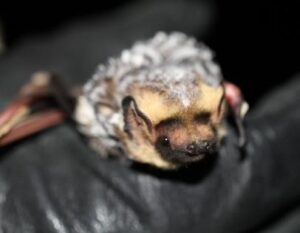
You found a bat!?

Great! You are one of the lucky few who has seen a bat. Millions of bats live close to people but most go unseen. Fewer still create problems. They are important predators of night time insects, and help to control many biting insects that feed on people, pets and other animals. Many people encourage bats to use their property by installing bat houses, or enhancing natural habitat, and benefit from having fewer pests. Bat-associated diseases are rare in Alberta. However, like with all wildlife, there are important procedures and safety considerations you should be aware of to ensure both you and the bat remain safe.


Visit the Community Science page for information on how to report your observations and to help monitor bat populations, as well as the Managing Bats in Buildings page for tips on how to help bats that are roosting in buildings.

What should you do when you find a bat?

Never touch bats with your bare hands. Like many wild animals, bats will defend themselves by biting if they feel threatened, such as when someone attempts to pick them up. Bites may be painless and often do not leave a mark, but there is potential to contract rabies from a bat bite (or scratch).


Rabies is a virus that occurs at low levels in bat populations throughout Alberta. Although human cases are uncommon, the disease can be fatal to humans or pets, so it is important to follow basic steps to prevent exposure and to treat it if it occurs. When left alone and kept out of human living spaces, bats are harmless and provide many benefits for human communities and the ecosystems on which we depend.

Although most bats do not have rabies, those in areas where people (or pets) can access them (e.g., on the ground) are more likely to carry it. Post-exposure shots must be administered as soon as possible after any exposure, or suspected exposure, because once rabies symptoms appear, the virus is almost always fatal. Rabies can also be prevented through vaccinations administered prior to exposure, but regular testing and booster shots are needed to maintain immunity.


The best prevention is to never handle bats with bare hands. Exposure typically occurs through accidental contact or deliberate handling of bats, not through bats seeking out people to attack. Bats should not be allowed to enter the interior living space of a home, although they can quite often safely use the exterior portions of a building, in locations where human contact is unlikely to be an issue. Pets should always have up-to-date rabies vaccinations. All mammals, including cats and dogs, can get rabies.
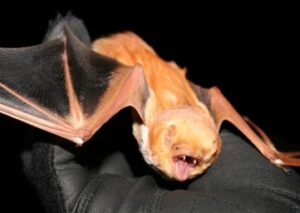
Have you or your pet been bitten (or possibly bitten)?

If you come into contact with a bat in Alberta, call the Alberta Public Health Veterinarian at 1-844-427-6847 or Health Link (8-1-1) for assessment. Health authorities should also be contacted if there is uncertainty about whether a bite or direct contact has occurred, such as when a bat is found inside a home’s sleeping quarters or a flying bat lands on or brushes against a person.


It is important you receive prompt medical attention from a doctor or nurse, even if you are unsure whether you were bitten. Treatment will typically consist of post-exposure prophylaxis, a series of shots that help your immune system destroy the virus during its early stages. These shots are typically small injections into a muscle in the arm or leg, much like other vaccinations we commonly receive.


Pets may also contract rabies, and should have up-to-date vaccinations. Talk with your veterinarian if you believe your pet has been exposed to rabies. Both cats and dogs can get rabies.

Other health concerns

Histoplasmosis (a lung disease caused by the inhalation of Histoplasma capsulatum fungal spores) has been reported in Alberta, but the risk of exposure is mostly unknown. The fungus can live in soil that has high concentrations of bat or bird droppings. People who inhale the fungus’s spores may become sick (it can cause fever, cough, and fatigue). Although most people can recover on their own (and may not even be aware they were exposed), more serious health consequences can occur, especially for those with weak or compromised immune systems.


The fungus does best in areas with persistent moisture or high humidity, but spores are especially likely to become airborne once the area dries and is subsequently disturbed. Appropriate respiratory protection, gloves, and coveralls should be worn if disturbing the feces of any wild animal, especially in confined areas such as attics. Wetting an area before cleaning (e.g., with a spray bottle) will help reduce dust generated during cleaning. If mice also have the potential to use the space, additional precautions may be required to avoid exposure to Hantavirus and other health risks (bats are not known to transmit Hantavirus). See Government of Alberta guidelines for more information on Hantavirus.


At least an NIOSH-rated N100 (high-efficiency) respirator should be used when cleaning feces or entering attics. Additional protection may be needed if asbestos or other environmental hazards are present (asbestos may be found in attic insulation and other areas, and requires at least a P100-rated respirator). In some situations, a professional will be needed to safely clean the area and make appropriate repairs.

Have you found a dead bat?

Do not touch bats, regardless of whether they are alive or dead. Bats may enter a state of ‘torpor’ during the day and throughout winter hibernation, which involves lowering their body temperature to conserve energy. This makes bats immobile, and they may appear dead. However, they will become active once they warm up their bodies and are still able to defend themselves.


If you are confident the bat is dead, the carcass can be delivered to a local Fish & Wildlife Office. Call the Alberta Environment and Parks information line at 1-877-944-0313 to locate your nearest office, or visit https://www.alberta.ca/fish-and-wildlife-contacts.aspx. Bats submitted to a Fish & Wildlife Office may be used as part of the province’s routine wildlife disease monitoring program. Carcasses found between December and June are particularly important for white-nose syndrome testing. If you need additional advice or assistance regarding living or dead bats, contact the Alberta Community Bat Program (info@albertabats.ca).

Have you found an injured or distressed bat?

Bats may become injured or stressed for a variety of reasons. Encounters with bats are most often reported during the late summer and fall, when young bats are learning to fly, and large numbers of bats are making long-distance movements to their winter habitats. During this period, bats may be found in highly unusual locations, such as the sides of buildings and under patio umbrellas. In most of these cases, the best option is to leave the bat alone – it may simply be resting until it can take off again the following night.


Sometimes bats fall to the ground, or end up in inappropriate locations. This is especially common among young bats during the fall. If the bat does not appear injured, it may be placed in an elevated location where it can take off into open flight and predators (such as magpies and cats) are unlikely to be a problem. Suitable locations may include a tree with extensive decay and other defects that provide hiding spaces for bats (e.g., sloughing bark, cavities, holes, cracks, breakage). Choose a location near a clearing so that the bat doesn’t crash once it attempts to fly and where people won’t come into contact with it. The bat will most likely seek shelter and rest until it is dark; if the bat is still there the following day, you may wish to contact a rehabilitation centre (see below). The bat may also be placed back into a roosting crevice from which it fell, if safe to do so. Be sure to wear thick leather gloves and clothing to cover bare skin if you need to move a bat.


Many bats also fall victim to house cats – a predator that North American bats are not well adapted to evading. Often, cats will kill the bat but leave the carcass, making the ultimate cause of death uncertain.


Bats exhibiting unusual behaviour, such as flying during the day, flopping on the ground, or showing no fear of humans, are more likely to be sick (possibly with rabies) and should be treated with care. Avoid the area where the bat is located and keep pets inside.


If you find an injured bat, contact your local Fish and Wildlife Office for advice and assistance. In some situations, a wildlife rescue or rehabilitation centre may also be able to help. Remember to always use safe procedures when handling bats – wear thick leather gloves if you are going to handle a bat and gently manipulate it with another object (such as a cardboard box). Bats cannot chew through fabric or cardboard, but they are fantastic at finding their way out of loosely closed bags or boxes (note that they can still bite people through fabric bags). If you must contain a bat, always ensure it is tightly closed, even if the bat appears inactive (but ensure it can access air to breathe). Note that keeping bats in captivity requires appropriate permits, so the best option is to contact a wildlife rehabilitation centre (see list below for Alberta Rehabilitation Specialists who will take bats).

List of Wildlife Rescue Organisations

Calgary Wildlife Rehabilitation Society
Website: http://calgarywildlife.org
Wildlife Hotline: (403) 214-1312
Email: wildlife@calgarywildlife.org
Mailing address: 11555-85th Street NW
Calgary, AB T3R 1J3


WILDNorth Northern Alberta Wildlife Rescue & Rehabilitation (formally Wildlife Rehabilitation Centre of Edmonton)
Website: http://wildnorth.ca
Phone (wildlife hotline): 780-914-4118
Email: info@wildnorth.ca
Mailing address: 12515 – 128 Street, Edmonton, AB T5L 1C9


Alberta Institute for Wildlife Conservation
Website: http://www.aiwc.ca
Phone: 403-946-2361
Email: info@aiwc.ca
Mailing address: P.O. Box 68, Madden, AB T0M 1L0


Medicine River Wildlife Centre
Website: https://www.medicineriverwildlifecentre.ca/
Phone: (403) 728-3467
Email: info@mrwc.ca
Mailing address: Box 115, Spruce View, AB T0M 1V0